Loading...
Serving Haltom City, TX and surrounding areas. (682) 271-0566
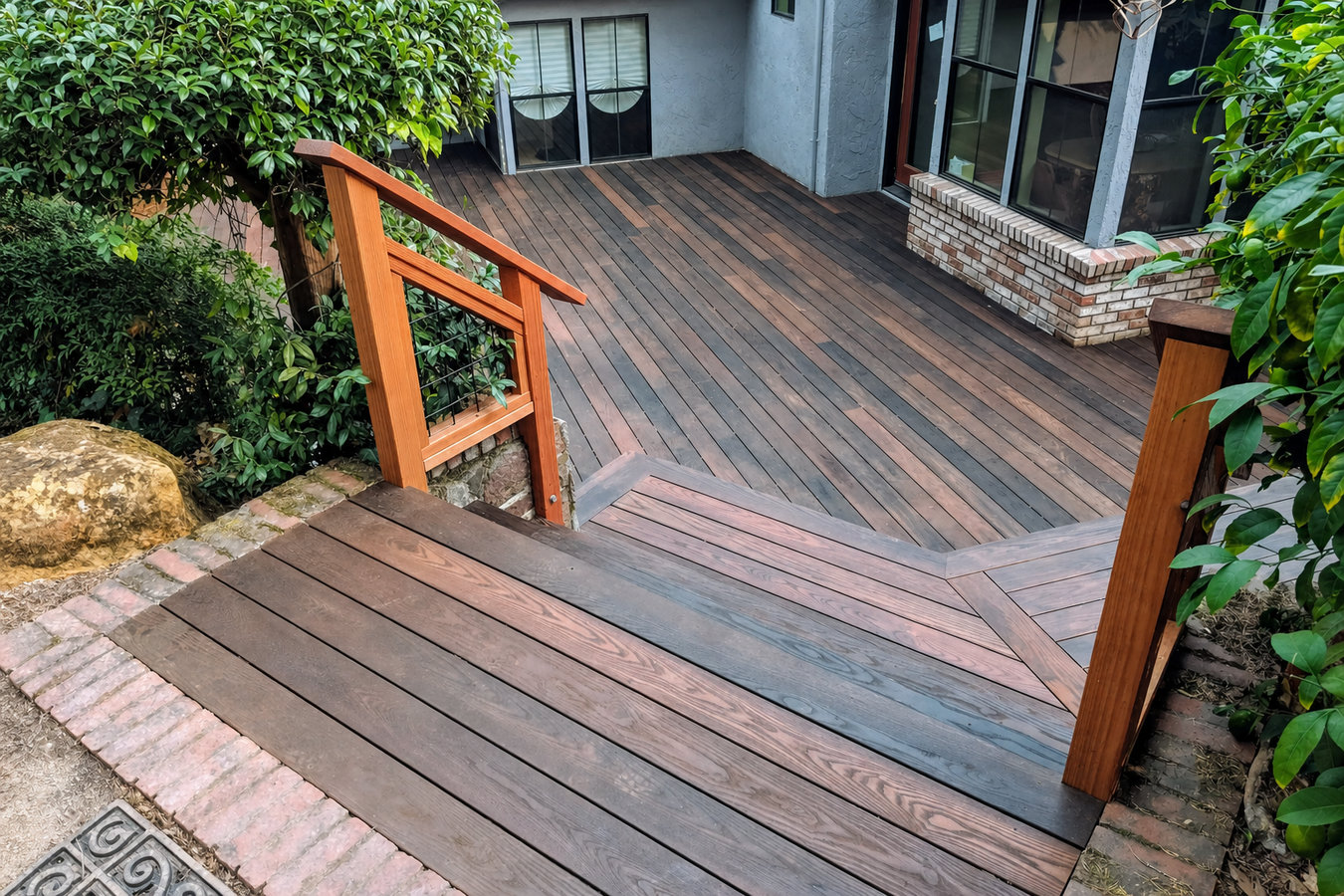
Your sloped yard is not a problem - it is an opportunity. A multi-level deck turns an awkward grade change into separate, usable outdoor spaces your family will actually spend time in.
Multi-level deck construction in Haltom City means building two or more connected tiers at different heights, typically following your yard's natural slope - most projects involve one to three weeks of active work once the permit clears. Instead of fighting a grade change with fill dirt or a dangerously tall single platform, the design steps down with the yard and turns each level into its own defined space.
A lot of Haltom City homes built in the 1950s and 1960s have backyards that slope away from the house - exactly the situation where a multi-level deck earns its cost. The older housing stock in this area also means many homeowners have original single-level decks that were never designed for the way people actually live outside today. If you are comparing options for what to build, our custom deck design and build page explains how we approach the full design process from the first site visit.
The biggest structural concern in this area is the heavy clay soil under your yard. It moves every time it rains and every time it dries out - and a deck built without accounting for that will show it within a few years. Post depth and footing design are the most important questions to ask any contractor before you commit.
If you step out the back door and immediately face a long staircase down to the yard, your property is a natural candidate for a multi-level design. A single flat platform at door height leaves a dangerously tall drop on the far edge. A two-level deck steps down with the grade - giving you usable space at both heights without a towering structure.
If your existing deck barely fits a table and four chairs, a multi-level addition could solve the problem. Many Haltom City homes built in the 1960s and 1970s have small original decks that were never designed for modern outdoor living. Expanding with a second tier is often more practical than extending a single flat platform.
If your backyard has a noticeable slope and you have given up on using the lower portion, a multi-level deck can reclaim that space. The lower tier can be built right at grade on the downhill side, turning what felt like a problem into a usable outdoor room. This is especially common in older Haltom City neighborhoods where lots were not graded flat during original construction.
If your existing deck has boards that are cracking, cupping, or turning gray and splintery, it may be time to replace rather than repair. North Texas heat and UV exposure break down untreated wood faster than in cooler climates, and a deck that has been neglected for several summers can reach the point where patching costs nearly as much as starting fresh. Replacement is also a natural opportunity to add a second level.
Every multi-level deck we build starts with an on-site visit where we look at your yard's slope, your home's layout, and how you plan to use the space. From there we design a structure that works with your grade rather than against it - and we handle the permit application through Haltom City's Development Services so you can focus on planning how you will use the finished deck. If you are still deciding between a multi-level build and a simpler expansion, our deck railing installation page is a useful companion - railings are required on the upper tier of any elevated multi-level structure and the choice of material affects both cost and long-term maintenance.
Material selection is one of the most important decisions in a multi-level build. Pressure-treated wood is the most affordable starting point and works well with regular maintenance - but in Haltom City's climate, that means sealing every two to three years. Composite decking costs more upfront and requires almost no upkeep, which is why it has become the more popular choice for homeowners who want a finished-looking outdoor space that stays that way. The Texas Department of Licensing and Regulation regulates residential contractors in this state - you can verify any contractor's license status there before signing anything.
The classic multi-level build that works with your grade change - upper tier at door height, lower tier at yard level, connected by built-in stairs.
One level for dining and grilling, another for seating or a lounge area - suited for homeowners who regularly host and want natural separation between activity zones.
The most affordable starting point - solid structure with a natural look that can be stained or sealed to match your home's exterior.
For homeowners who want a finished, low-maintenance outdoor space that holds up through years of North Texas heat without annual staining or sealing.
Haltom City was largely built out in the 1950s through 1970s, and many of those older neighborhoods have lots that were never graded perfectly flat. Homes with a back door that opens several feet above the yard are common - and a single flat deck at door height leaves you with either a steep drop on one end or a long, awkward staircase eating up yard space. A multi-level design solves this elegantly by stepping down with the natural grade. Homeowners in North Richland Hills and Richland Hills share many of the same housing stock and yard conditions, and multi-level builds are among the most requested projects across all three communities.
The other local factor that shapes every multi-level build here is the clay soil. Haltom City sits on the same expansive clay that runs through much of Tarrant County - soil that swells after heavy spring rains and then pulls back hard during a dry summer. Post holes have to go deep enough to anchor below the zone where the soil is actively moving. This is not optional or a premium add-on - it is the baseline requirement for any deck in this area that is expected to stay level for more than a few years. The Texas A&M AgriLife Extension has published guidance on building in expansive clay soils that is worth reading if you want to understand the engineering behind it.
Reach out and describe what you are thinking - we will schedule a free on-site visit, usually within a few days. Multi-level deck costs depend heavily on your specific yard slope and layout, so we need to see the property before giving you a written number. You will have your estimate within one business day of that visit.
Once you approve the design and sign a contract, we draw up plans and submit the permit application to Haltom City's Development Services department on your behalf. Permit approval typically takes one to three weeks - work cannot start until that comes through.
Work begins with digging post holes and setting them in concrete. In Haltom City's clay soil, holes go deep enough to anchor below the active movement zone. After the concrete cures, we build the structural frame - a city inspector visits at this stage before the surface boards go down.
Surface boards are installed, followed by stairs, railings, and any built-in features. A final city inspection confirms everything matches the approved plans. We walk you through the finished deck before we leave - including the maintenance schedule your material needs in this climate.
Free on-site estimate. Written quote within one business day. No obligation to move forward.
(682) 271-0566Every multi-level deck we build in Haltom City goes through the city's permit and inspection process. We handle the application and inspector scheduling so you never have to figure out the paperwork. A permitted deck is a documented, insurable, sellable asset.
The clay soil throughout Haltom City moves with every rain and every dry stretch. We dig every footing past the zone where the soil is actively shifting and set posts in concrete - the step that separates a deck that stays level for 20 years from one that starts leaning after three.
We help you pick decking and hardware that are proven to hold up under sustained 100-degree summers and intense UV - not just what looks good in a catalog. That means less maintenance, fewer repairs, and a deck that does not look tired before it has paid for itself.
We have built decks across Haltom City and the surrounding area for years and know the permit office, the soil conditions, and the seasonal variables that affect every outdoor build here. The North American Deck and Railing Association sets the industry standards we build to on every project.
Multi-level decks are among the more complex outdoor builds - the structural engineering has to account for two separate load paths, the permit process involves more documentation than a single-level project, and the post depth requirements in Tarrant County clay are non-negotiable. We have done this work across Haltom City and neighboring communities long enough that none of those variables surprise us.
Every multi-level deck needs safe, code-compliant railings on the upper tier - see our railing options and what installation involves.
Learn MoreStart from scratch with a fully custom deck design that accounts for your home's layout, your yard's grade, and how you plan to use the space.
Learn MorePermit slots and build schedules fill up fast in spring - reach out now to lock in your start date before the heat makes outdoor construction harder.